80’s Invasion Tour 2016 (Midge Ure, Big Country, Nick Heyward, Curiosity Killed the Cat) – through March: http://www.ticketline.co.uk/80s-invasion-tour#bio
The Smithereens – through April: http://officialsmithereens.com/shows/
The Cure – May through December: http://www.thecure.com/events/
The English Beat – February through March: http://englishbeat.net/shows/
Simply Red – February through August: http://www.simplyred.com/tour-dates/
Nick Lowe – March: http://nicklowe.com/tour-dates/
Duran Duran – March through August: http://duranduranmusic.com/?page=tour
Elvis Costello – March through June: http://www.elviscostello.com/dance-card
Billy Idol – February through May: http://billyidol.net/tour/
Agent Orange – February: http://www.ticketmaster.com/Agent-Orange-tickets/artist/734398
Jesus and Mary Chain – February through March: http://thejesusandmarychain.uk.com/
B52s – February through April: http://theb52s.com/tour/
Lene Lovich – April through June: http://www.lenelovich.net/tour.htm
Howard Jones – February: http://www.howardjones.com/tour_dates.html
Berlin – February through April: http://www.berlinpage.com/tour
Violent Femmes – March: http://www.vfemmes.com/tour/
The Monochrome Set – February through June: http://www.themonochromeset.co.uk/
The Stranglers – March through April: http://www.thestranglers.net/
Movie Soundtracks: Christiane F.
Posted: January 16, 2016 in Art Rock, Rock, SoundtracksTags: 1981, Christiane F., David Bowie, Soundtracks
I had some friends over last night to celebrate the music and films of David Bowie. The playlist spanned Bowie’s career from the early ‘70s to the 2010s. (It wasn’t easy narrowing down Bowie’s catalog to a three hour playlist). The movie we chose to watch was Nicolas Roeg’s The Man Who Fell to Earth. As we were discussing Bowie’s music in movies, someone mentioned a film I had never heard of – Christiane F. It’s a German film about a teen growing up in a bleak part of West Berlin in the mid-70s who falls in with a drug crowd and eventually becomes a heroin addict. Bowie provided the soundtrack for the movie and also appears in the film. One of the first things I did today was watch the movie on YouTube.
Based on the non-fiction book Christiane F. – Wir Kinder vom Bahnhof Zoo, the film is about a bored young girl sick of her uneventful life who finds excitement inside the walls of the Sound, a popular youth nightclub. While there she meets and falls in love with Detlev, a 15-year-old heroin addict who we later learn supports his habit by male prostitution. By age 14, Christiane is addicted to heroin and has also resorted to prostitution to feed her addiction. The movie, directed by Uli Edel, was released in 1981 and caused a sensation upon its release in Germany. Not only was the story shocking it also brought to light an epidemic of youth heroin addiction that was sweeping across Europe. The movie was also given a somewhat wide release in the US but didn’t make much of an impression, probably due to its grim subject matter.
With how much Bowie’s appearance in the film was promoted, I was surprised that he had so little to do with the storyline. Except for a live concert appearance (which seems somewhat out of place), his music is mostly used as a backdrop to the story. Most likely the studio was trying to cash in on Bowie’s popularity. Although the movie is set in the mid-70s, the soundtrack draws largely from Bowie’s Berlin trilogy recorded a couple of years later. As Christiane first enters the Sound, “Look Back in Anger” is blaring from the speakers, and “Boys Keep Swinging” is played during a gang fight prior to a Bowie concert (both songs from the 1979 Lodger album). Regardless, the music adds to the hopelessness and despair to one of the most disheartening movies I’ve seen in a while.
In the film, Bowie performs “Station to Station” off the self-titled album. Since Bowie was performing on Broadway at the time, some of the crew and cast members were brought over to New York City for filming. If I’m not mistaken, you can see the beginnings of his Let’s Dance look.
After Christiane meets some new friends at the Sound, they decide to have some fun by running, and falling, and wreaking general havoc in a subway station to Bowie’s “Heroes.”
Not much more needs to be said so thought I’d share this fan video tribute. Ah, the stars will indeed look very different today…
Classic Video: The Psychedelic Furs
Posted: January 9, 2016 in Alternative, Classic Videos, New Wave, Post-PunkTags: 1981, 1986, Pretty in Pink, Talk Talk Talk, The Psychedelic Furs
The Psychedelic Furs’ “Pretty in Pink” was a song with two lives, pre- and post-John Hughes. I prefer the grittier pre-Hughes version, which is probably an opinion shared by most Furs fans. The song was originally released in 1981 and is the first track off the album Talk Talk Talk. With its darker and moodier feel, the original is a much better fit with the cynical lyrics of the song. As many songs that fed my love of new wave, I first saw the video on MTV. I loved the song then and still do. The song reached #43 on the UK charts, but did not make a mark in the US until the mid-eighties.
Years later, Molly Ringwald brought the song to the attention of John Hughes and history was made. The band recorded a more upbeat and polished version of the song in 1986, and a new video was made to promote the Pretty in Pink movie. Even though they went along for the ride, the Furs weren’t too pleased with the changes and thought Hughes failed to capture the spirit of the song. As Richard Butler told Mojo magazine, “The song was about a girl who kinda sleeps around and thinks it’s really cool and thinks everybody really likes her, but they really don’t…It’s quite scathing.” Regardless, it was the song that really put the Furs on the US map and was their highest charting single in the UK, peaking at #18.
Albums Turning 30: Public Image Ltd and The Church
Posted: January 6, 2016 in Albums, AlternativeTags: 1986, Heyday, Public Image Ltd, Rise, Tantalized, The Church
I’ve come across several lists of albums turning 30 this year. There are some great albums on these lists, and at one time I owned quite a few in some form or other. With so much good music having come out in 1986, I thought it’d be fun to do a series of posts on songs from albums released that year.
The first song I’m starting with is Public Image Ltd’s “Rise.” It was the first single released from PIL’s fifth album Album, released January 26, 1986, and is reportedly about apartheid. It was the biggest chart topper by the band, reaching #11 on the UK charts, and placing #206 on NME’s list of 500 Greatest Songs of All Time. Although I wasn’t old enough to go clubbing upon its release, I do remember dancing to this song years later. After a while, the dance floor turned into one collective up and down motion. May the road rise with you…
I was a big fan of The Church in the early ‘80s but lost track of them until the single “Under the Milky Way” came out in 1988. I’ve since discovered the band’s music from the mid ‘80s, and glad I did. The album Heyday, released in the US in January of 1986, in my opinion, is one of their best. It’s also probably one of their most overlooked. My favorite song off the album is “Tantalized,” by far the most fast-paced and hard-edged song off the LP.
The Blitz Kids
Posted: January 4, 2016 in General, New Romantic, New Wave, SynthpopTags: Blitz Kids, New Romantic movement
Ah, the New Romantics – the big hair, the makeup, the frilly clothes – and that was just the men. With my love of new wave music, I’m not sure why it took me so long to stumble upon the Blitz Kids, who originated the New Romantic movement. Those familiar with the Blitz Kids know how influential they were in this movement, and ‘80s culture in general. It was while researching the New Romantics that I became acquainted with this group of musicians, art students, and “unruly” teens who were so instrumental in shaping what ended up being the most dominant genre of music and fashion in the early ‘80s. Members of this prestigious set included Boy George, Marilyn, Steve Strange, members of Bananarama, and John Galliano, just to name a few.
Origins and Fashion
It all started in 1978 in London, where a club called Billy’s held regular Bowie nights. The themed night drew kids disillusioned with the punk scene, and art and fashion students from local colleges. After a few months the group moved on to the Blitz wine bar for regular Tuesday night gatherings. The crowds donned looks from the English Romantic period, Berlin Cabaret, to retro Hollywood, and androgyny ruled the day. The extravagant fashion was a rejection of the stripped down look of punk. Steve Strange (later of Visage) manned the door with an iron fist, and if you did not live up to his creative standards you were not getting through the door. If you were able to get in, you would get the chance to mingle with the likes of Siouxsie Sioux, Midge Ure, and Billy Idol. Below are photos that capture the fashion and attitude of those Tuesday nights.
A shot outside the Blitz

Steve Strange (middle) and Boy George (right)
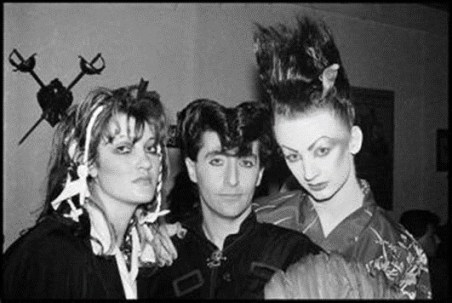
Marilyn (left), DJ Princess Julia (Julia Fodor), Boy George (right)
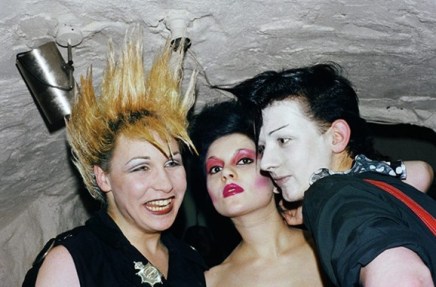
Martin Degville, pre- Sigue Sigue Sputnik
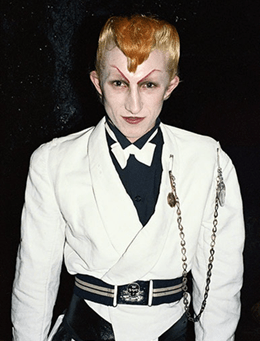
The Music
But it wasn’t all about the fashion. It all started with the music. And the music at the Blitz was described as “electro-diskow.” This consisted of European disco (think Giorgio Moroder), German bands such as Kraftwerk, glam rock bands like Roxy Music and, of course, David Bowie. A favorite dance move saw partners hold hands, lift their knees up to their waist, and spin and hop in a new kind of jive, as seen in the video for Duran Duran’s “Planet Earth” (see the 2:53 mark). Duran Duran actually recruited some of their Blitz Kid friends for the shoot. David Bowie also had some Blitz Kids appear in the video for “Ashes to Ashes.” It wasn’t long before bands started to emerge from the scene. The most notable were Spandau Ballet, who got their start playing cabaret nights at The Blitz, and Visage. The heavy synth and electropop sound would dominate the airwaves well into the decade.
Legacy and Influence
Although nights at the Blitz only lasted a couple of years, the influence of the Blitz Kids and the New Romantic movement on music, club culture, and fashion could be felt for decades to come. Designers such as Vivienne Westwood based their whole collections on the New Romantic look, and the clothes were worn by such acts as Adam and the Ants and Bow Wow Wow. Bands such as Duran Duran, Depeche Mode, Heaven 17, Human League, and ABC, who were all heavily influenced by this movement, found regular rotation on MTV and helped shape ‘80s synthpop music. Steve Strange and his group also revitalized the London nightlife and created the idea of theme nights that have become a staple of club culture to this day. Oh, to be able to have just a peek at what went on inside the Blitz during those years. On second thought, I probably would have never made it through the door.
For more on the Blitz Kids, here’s a documentary from 2005.
30 Albums Turning 30 in 2016
Posted: January 2, 2016 in Albums, Alternative, GeneralTags: 1986, albums
The folks at Sonic More Music took the time to put together a list of 30 alternative albums turning 30 this year. There are some true classics on here. What a great year for music!
Happy ’80s New Year!
Posted: January 2, 2016 in Alternative, General, Goth, New Wave, Playlists, Post-Punk, SynthpopTags: 1987, Can You Believe It?, He's Frank, The Bolshoi, The Monochrome Set
I look for any occasion to get a group of ‘80s music lovers together, and NYE seemed like the perfect opportunity. Since we’re both not too keen on venturing out on NYE, my husband and I decided to throw a dinner party to ring out the year. Fortunately, all attendees either grew up in the ‘80s or had a love of ‘80s music. With that kind of crowd, I couldn’t help but put together a playlist of songs from the era that included old favorites, rediscoveries, and new music I’ve come across this past year. Oh, we also attempted to play some games but the music took over and our living room became a dance floor until the wee hours of the morning.
Along with the usual suspects (Depeche Mode, Duran Duran, The Smiths, etc.), the playlist included songs from bands I had forgotten about over the years. Bands such as The Members (“Working Girl”), The Producers (“She Sheila”), Wire Train (“Chamber of Hellos”), and Felony (“The Fanatic”) found a much overdo spot on the playlist. Although sharing forgotten songs with the group was enjoyable, it was the unearthed gems I was most looking forward to playing. For a few, it was the first time hearing some of the songs and for others they brought back fond memories.
One of the bands I recently rediscovered is The Bolshoi. I knew of The Bolshoi back in the day but embarrassingly had never listened to any of their songs. My current favorite (and one I can’t seem to stop playing) is “Can You Believe It?” off their 1987 LP Lindy’s Party. It features an addictive, bouncy synth line and a heavy drum bass. I’ll definitely be seeking out more from them for a future post.
Another band discovered this past year is The Monochrome Set. From what I’ve come across they were favorites of Morrissey and Johnny Marr. This is another band that I’ll be exploring and posting about in the New Year. The song “He’s Frank” was first released as a single in 1979 and re-released as a slightly different version years later. I prefer this version, in which they sound like a cross between the Violent Femmes and The Velvet Underground. Just as above, there was no official video for the song available.
I’ve been away for a while but am looking forward to sharing more classics and overlooked songs of the ‘80s in 2016!
Remembering Michael Been
Posted: March 17, 2015 in Alternative, RockTags: 1984, 1986, Everywhere I Go, Michael Been, The Call, The Walls Came Down
Who’s Michael Been, you might ask? Michael Been was the singer of the rock band The Call. In my opinion, one of the most underrated bands of the ’80s. Today would have been his 65th birthday so I thought I’d take the opportunity to repost a blog entry from last September.
Taking Another Look at The Call
The Call was an American band that had mediocre chart success in the eighties. Their lyrics were politically charged and there was a passionate, anthem-like quality to their music. They were considered rock but there was definite new wave influences. The Call were critically acclaimed and admired by some of the biggest acts of the time but for whatever reason they were never able to achieve commercial success. Maybe it was because lead singer Michael Been just didn’t have the look that the MTV generation wanted. He was stout and scruffy and wasn’t the flashiest of front men, but he could sure belt out a song with as much emotional sincerity as the best of them.
They also had quite a long run, having been active from 1980 to 2000. Their biggest chart success was with the single “Let the Day Begin,” which reached No. 51 on the Billboard Charts in 1989. (Side note, this was Al Gore’s campaign song for his run in 2000). But it was their earlier material that made me a fan. Sadly, Michael Been died in 2010 at the age of 60. He was on tour as a soundman for his son’s band Black Rebel Motorcycle Club when he had a heart attack at a show in Hasselt, Belgium. I’ve always regretted not seeing them in concert, as I hear they were a pretty great live band.
One of my favorites from the group is “The Walls Came Down.” A song that combines biblical references with an anti-war message. The year was 1984, after all. It’s a pulsating, urgent song with plenty of Michael Been howls.
“Everywhere I Go” is a single off of the 1986 album Reconciled. It was no secret that Michael Been was deeply religious, and it’s on full display on this track. Another guitar and drum-driven tune with Been at his growling best. Listen closely and you can hear Jim Kerr of Simple Minds and Peter Gabriel on background vocals.
Classic Video: The Smiths
Posted: February 11, 2015 in Alternative, Classic Videos, Post-PunkTags: 1985, How Soon Is Now?, The Smiths
When it comes to classic songs of the eighties, you can’t get more classic than The Smiths’ “How Soon Is Now?” Some have called it the “Stairway to Heaven” of the eighties. I remember hearing the song on college radio in the mid-eighties but didn’t see the video until years later. Included on the album Meat is Murder, which was released 30 years ago today, the song was originally intended as a B-side. But with the perfect combination of Johnny Marr’s haunting guitar and Morrissey’s somber lyrics, it was destined to be the group’s biggest and most enduring song.
Known for its swirling, dreamy guitar work, the song was the result of much experimentation with reverb, rhythm tracks, and harmonization. Marr told Guitar Magazine that achieving the changing pitch of the guitar (vibrato) took some time and he has since forgotten how to recreate the slide guitar sound. He also lamented that not writing down the process on the slide part has been “one of the banes of my life.”
Upon hearing the single, the record company, Rough Trade, didn’t think much of it and felt it didn’t represent The Smiths’ sound. Plans for the song as an A-side were thrown out and it became a B-side to the 1984 single “William, It Was Really Nothing.” Despite this, the song was picked up by British DJs and later that year was the most requested song on many prominent shows. Although it failed to chart upon its initial release, it wasn’t until its re-release as a single in 1985 that it made the UK charts (reaching #24).
The US release of the song, by Sire Records, was accompanied by an unauthorized video. The band was not a fan of the video and thought it was degrading. Regardless, it gave the band great exposure in the US and helped make it their most famous song. The track has gone on to make numerous lists of best songs of the eighties, topping some lists as the greatest song. Although it might not be the greatest representation of The Smiths’ “sound,” it definitely earned all the accolades and its place in the annals of best and most influential songs of the decade.
 Living In Oblivion